JohnnyB
-
Posts
11,473 -
Joined
-
Last visited
-
Days Won
11
Content Type
Profiles
Forums
Events
Everything posted by JohnnyB
-
Spun two albums yesterday afternoon. First, continuing my Rolling Stones binge with Tatto You in great condition, an LP rescued from Value Village for $1. You don't usually find popular albums from iconic bands in thrift shops in playable condition, but somehow this one was there waiting for me. Great sound quality too. The album starts off with "Start Me Up." I really like this album. I followed that with Linda Ronstadt's Greatest Hits vol. 1. This one brought back a lot of memories including a cover band I was in in SoCal in 1976. We did a lot of California rock--Eagles, Jackson Brown, Linda Ronstadt, etc. ... also left me with a bit of melancholy as she has Parkinsons and can't perform anymore. What a talent and set of pipes she had!
-
In a fit of eclecticism I spun Buddy Rich's 1966 "Swingin' New Big Band" followed by The Stones' "Let It Bleed". Here are sample cuts:
-
I spun this (vinyl) while making chili in the kitchen. I love the Rossini overtures. Most of us are only familiar with iconic snippets used for "The Lone Ranger," old cartoons and SIlly Symphonies, and "Prizzi's Honor". I love listening to the complete overtures.The energy that goes with them helps get me up and going to get things done in an empty house. This particular recording is conducted by RIccardo Muti, a native Italian who really gets Rossini. I never before heard such fast tempos for some of the passages, yet, true to the Italian way, the fast passages serve the musical flow, imparting the musical equivalent of a delicate filagree to an inlay. When you hear something in its true native mode it can be particularly enlightening, and Muti really lights up Rossini. However, the overtures aren't exactly the complete story, either. As full as they are compared to the snippets, overtures themselves are preludes to complete operas, summaries of the melodies that propel the operas that follow. I have a box set of the Barber of Seville opera; I'll have to give it a spin soon.
-
Ben Webster: See You at the Fair Ben Webster is definitely on the short list of the early wave of tenor sax legends along with Lester Young and Coleman Hawkins. Webster and Young were born in 1909; Hawkins in 1904. By contrast, Coltrane and Stan Getz were born in 1926 and 1927, respectively. The album has a sort of thematic tie-in with the New York World's Fair of 1964-5, 52 years ago. I'm old enough to remember that fair well, and witnessed picture-phone hookups from Disneyland to the Fair (and back) that summer of '64. Anyway, there are some interesting side men on the album, particularly Hank Jones and Roger Kellaway alternating on keys. Kellaway became better known for writing the music for "All in the Family" and other TV and film soundtracks. He was only 24 on this album, a full 30 years younger than Webster. Anyway, it's a really nice listen, especially for the 99 cents I paid for a pristine copy in a bargain bin. The best thing is the time machine element--hearing analog reproductions of music geniuses born over 100 years ago as though they're in your living room, because that's what those '60s-era Impulse records do.
-
Well, after all the things I post of 60-, 80-, 100-, and 250 yr-old music, I thought I'd advance to this 20th century album from a scant 32 years ago, Heatbeat City by the Cars. I have the LP but while sorting through the garage a few days ago I came across the pre-recorded cassette, which I bought the year of its release for my 75-mile round trip commutes, and played it in the Town Car while I ran errands today. Now I'm going to play the LP while I putter around the house. I loved New Wave and Power Pop when they hit big in the early '80s and this is one album where the phasing, overdubs and use of synth is well blended, enhances the songs and has held up over time. This is a great album. Every song is a keeper, and the sensation of one good song after another reminds me of early experiences with Beatles albums that had no filler. I found the title track which closes the album to be particularly touching the way that Ocasek's quivering vocals convey the sense of sadness and loss. At that point I think I understood the title, "Heartbeat City," describing the pounding heartbeat you might experience when encountering an important lover from years before, as in the line, "Jacki, what took you so long?"
-
Dwight Yoakam, Guitars, Cadillacs, Etc., Etc. This album is a masterpiece in so many ways. The sound quality, the mix, the mastering are all first rate. The band is very tight with a great blend, with acoustic instruments including slide dobro with fiddle and mandolin blended with steel guitar and twangy electric guitar. But it is the songwriting, the crafting and content, that make this album a masterpiece--the voice of the displaced Appalachians who left their beloved homes among the hills to take jobs up north for financial reasons. It was that or work the coal mines. One of the songs is dedicated to Dwight's grandpa, who worked the mines for 40 years. In the summer of '63 was a hit song named "Detroit City" or "I Wanna Go Home." It was the lonely lament of a (probable) Appalachian who's an autoworker by day in Detroit, but spends his evenings at the bars, lonely and self-sedated. Yoakam's album takes this concept and explores it much further, and he knows what he's writing and singing about. He was born in Pikeville, KY, which is practically the epicenter of Appalachian culture. It's the county seat of Pike County, the site of the trials and public execution resulting from the McCoy/Hatfield feud. He grew up in Columbus, however. He wrote all but a couple of the songs including one called "Bury Me" by the Big Sandy, which is the river that runs through Pikeville. This displacement has personally affected me as well. I'm from Cincinnati and have spent a cumulative 29 years there. In Cincinnati is an incorporated town within the borders of Cincinnati named Norwood. For a long time Norwood was home to the manufacturing plant for the original Camaros and Firebirds. It was like a miniature Detroit with Appalachian autoworkers, lots of country bars and clubs, and a twang in the local accent. I also married into families with Appalachian roots, twice. My first wife's grandparents were from small towns in central KY, and my present wife's sister-in-law is actually from Pikeville, and my wife's father was also from Kentucky. Although he became an accomplished opera baritone and music director, my wife has memories of him getting together with his cousin and they'd pull out their guitars and have a go with old gospel and country songs.
-
Yeah, it was incredible--16" high, the inner frame was handcrafted from rattan, the covering was white rabbit fur and it stayed on my head thanks to an overlapping armor plate chin strap.
-
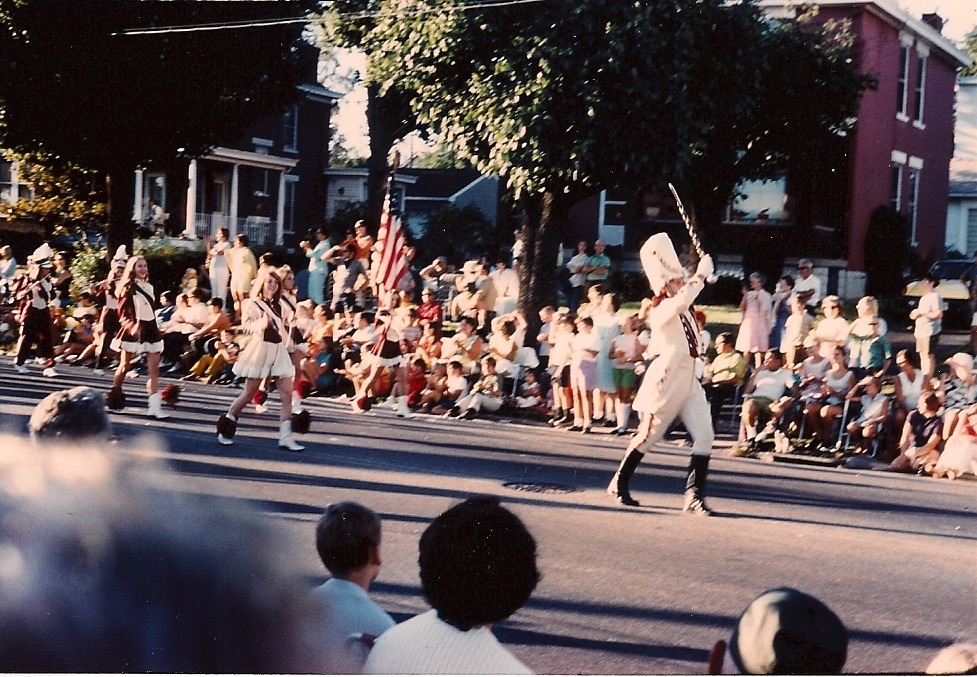
For Independence day yesterday, I spun a still-sealed NOS LP of this: Ironically it's on the London label and played by a British military band. But it's a great-sounding record and the Brits play Sousa with a finesse that brings out the art and subtleties of Sousa's finely crafted marches. The music took me to a happy place of local parades, football games, and being drum major in high school.

-
1962 Columbia recording of the Duke Ellington and Count Basie orchestras together, playing each other's charts separately and together, drum battles between Sonnny Payne and Sam Woodyard. Great, great big band swing x 2.
-
Some of the best LPs in my collection are from the 99-cent bins.
-
Continuing on my Metheny and Charlie Haden kicks, after playing Bright Size Life (Metheny/Jaco/Bob Moses) I came across this in my Metheny section: Recorded in 1985. The drummer in the trio is the redoubtable and legendary Billy Higgins, who has played on over 700 albums including Ornette Coleman's "Shape of Jazz to Come" of 1959 with Haden on bass. This is a wonderful album. Haden was around 47, and Metheny was at his lyrical best. I really like his jazz trio albums because he plays great straight-ahead jazz guitar. I've heard Metheny recordings in a wide variety of situations with many great drummers including Jack DeJohnnette, Bob Moses, Dan Gottlieb, and Roy Haynes. But Billy brings such a bouncy, airy, light yet propulsive touch to this party. This is a great trio album where each member is a top player and their collective sense of ensemble and resulting musical conversation is top notch. ... Well, that's my impression of Side 1 from start to finish. Side 2 is another matter, where Pat trots out the guitar-synth for most of it, which--while creative in its own way--I could do without, at least today. Doesn't bother me, really. The album is in pristine condition and I got it from a 99-cent bargain bin. $0.99 for a side, not bad.
-
On Amazon the CDs are easy to find but the LPs are few and expensive. However, there are quite a few at reasonable prices on eBay. In Seattle we have several large record stores. One of them had a claimed inventory of over 10 million LPs. I managed to snag an Ex+ condition Bright Size for $8.99 around 2008-9.
-
Do you have this recording? I chased it down as a CD in the mid-'90s. Then when I went back to vinyl, I picked up an original ECM LP. If you want a simple distillation of Jaco's genius embedded in a stunning musical conversation, this is the album. Pat was a mere 21 yrs old when this was recorded. They recorded it in a day, and you'd think they had grown up together. If you don't have this one, GET IT!
-
Spun this one Friday and Saturday. It's a 2-LP set. I have been a Charlie Haden fan for close to 30 years, and yet somehow I missed the memo when he died on June 11, 2014. Over the years he has done many duet collaborations with artists such as Jim Hall, Pat Metheny, and two with Hank Jones. This one was recorded in 2007 but wasn't released until January 2014. Charlie's prowess on double bass covered a wide range of styles and tempos. On many of these duets he's pretty laid back, very melodic, and makes no attempt to show off virtuosity. One thing I noticed in these recordings, however, is how his collaborations really bring out the "A-Game" of these already brilliant artists. I have at least a half dozen Keith Jarrett albums, but this one has a touch and sensitivity that goes beyond his usual creativity and brilliance. Available on CD, mp3, and vinyl. In addition to everything else, Charlie was Jack Black's father-in-law.
-
And that's Frank Whaley who also played Robbie Krieger in Oliver Stone's film, "The Doors," released the same year.
-
Soul on Top, a collaboration between James Brown and jazz drummer extraordinaire Louie Bellson. Others on the project included legends arranger/conductor Oliver Nelson, Jimmy Cleveland on trombone, Pete Christlieb on tenor sax, and Ray Brown on bass. It was recorded at King Studios in Cincinnati where James recorded most of his monster hits. It was released in 1970 when Brown was at his absolute peak in vocal maturity, range (damn, what a range!), and expressiveness. I posit that--given that JB initiated this project and approached Louie Bellson for it--it demonstrates his broader musical knowledge and taste as well as his range of material that he absolutely masters. It has everything from "Your Cheatin' Heart" to "It's a Man's World" like you've never heard. Available on LP, CD, and iTunes. Really clean recording that puts James in the room.
-
Thunderbird by Louie Bellson. 1966 Impulse recording, 1972 pressing, excellent quality. It's an octet featuring some greats including Harry "Sweets" Edison on trumpet. Louie in his prime, what a drum monster, an impeccable time keeper, subtle comper who could bring things to a roar as well. It's when he looked like this and played thie Rogers kit. This kit is basically the same in drum and cymbal sizes and positions as the kits of Gene Krupa and Buddy Rich, but with a second bass drum, a feature Louie originated for an art project when he was 15. He was ambidextrous and a master at it.
-
I wish I were spinning "Sign o' the Times," but somehow the prices on that album have suddenly skyrocketed. I do have the CD version. I'll play it in the car.
-
I was playing a couple of Hank Jones jazz combo albums today. Hank is one of the three Jones brothers, each of whom had a major impact on jazz: Hank on piano, Thad on trumpet, and Elvin on drums. I started with "Hanky Panky, with Ron Carter on Bass and Grady Tate on drums. Can't get much better than this. But then I put on "Just for Fun". I'm thinking, who's that guitarist? He's really hot. Umm, Howard Roberts. And that bassist has serious chops and a great sense of melody. Of course he does! It's Ray Brown. And that drummer really drives these tunes... Like very few would, it's Shelly Fuckin' Manne! These black platters made for a great afternoon.
-
It's not just you. It's probably a universal condition. I read a book called This is Your Brain on Music, which describes how the things we learn from around age 5 to early 20s, especially 10-20, forms our basic schema, or frame of reference for our lives, and not just in music. It explains why things taught in those years become our "go-to" collection of knowledge, opinions, and preferences. And--related to the book's title--explains why the music we listen to from age 8 to 20 forms the backbone to what we prefer the rest of our lives. I turned 10 in November 1963, just a few weeks before The Beatles hit the US airwaves. I grew up on the Beatles, Beach Boys, Doo-Wop, Ray Charles, Santana and the Woodstock performers (I was going on 16 then), etc. When I was 11 my sister sent me a Gene Krupa Big Band album. Soon after another sister gave me a Dave Brubeck album. The family at home played classical music records and we went to the symphony on occasion, plus I studied piano under a classical piano professor. So I have a broad schema including heavy concentrations in classical and jazz in addition to the pop music hitting the airwaves at the time. Once you get your head wrapped around the formation of a musical schema, it's easier to see why people around my age love The Beatles, Hendrix, Cream, Stevie Winwood, the Stones, etc. while others are into KISS, or Malmsteen, Journey, Rush, Death Metal, or whatever. It's what you heard and internalized in that vital 10-20 yr-old schema-building core.
-
Still giving my monophonic cartridge a workout. I continue to find original '50s and '60s pressings I picked up at thrift shops or from eBay. Yesterday I spun Encore of Platters Golden Hits. This is a collection of big hits originally recorded from 1955 to 1959--56 to 60 years ago. Do you remember the scene in "American Graffiti" where Ronnie Howard and Cindy Williamson are slow dancing to "Smoke Gets in Your Eyes" at the school dance? That was the Platters. It's on this record along with "The Great Pretender," "Only You," "Twilight Time," "I'm Sorry," etc. Right now I'm spinning this original pressing from sessions recorded in 1954-55: Mine's an unjacketed, unused double-disk DJ copy I got off eBay. An all-star ensemble including Oscar Peterson, Ben Webster, Sweets Edison, Thad Jones, Freddie Green, Barney Kessel, Ray Brown, and several more. Full credits listed here. . . . . . . . . Now I've moved on to this. Nat King Cole and Buddy Rich. Who knew Buddy and Nat ever collaborated? Having Lester Young on tenor doesn't hurt either.
-
Continuing my mono marathon, I pulled out this, the most amazingly meticulous LP reissue I've probably ever heard--Nat King Cole with his trio and just a few legendary jazz cats (e.g., Sweets Edison, Stuff Smith, Juan Tizol) to flesh out a small, very jazz ensemble. No treacly violins yet. This was mastered at 45 rpm and pressed the best way possible. Finally hearing it in native mono playback with a really good mono cartridge, this is probably the best sound I have ever gotten from my LP rig. The performance is perfect, Nat is in the room, and the recording is stunning. Nat's voice, the piano, electric guitar, bongos (Tizol), and drum kit have that "spook factor," as though they're all in the room. I finished up last night by digging out an original 1965 mono pressing of Janos Starker's legendary rendition of the Bach Cello Suites on Mercury Living Presence. My sister sent me her original copy when I got into vinyl again. When I first played it years ago, it was a bit noisy and betrayed some inner groove distortion. Played with a mono cartridge with conical stylus, however, the dirt noise and groove distortion largely disappeared, leaving a first generation performance of a cello master in my living room. This recording is such a classic that whenever Starker changed labels they wanted him to do the Suites on their label as well. He ended up doing them something ilke 7 times on as many labels. 50 years later, however, the original Mercury Living Presence version, like the Dude, abides. It is still in print, in multiple formats: CD, 3 LP set, and mp3, 24/192Khz hi-def, and ultra high-rez DSD downloads.
-
Yesterday I took delivery of a nice mono cartridge to get the most out of the all-analog Beatles mono reissues on vinyl. It was quite a revelation. As good as these LPs sound with a stereo cartridge, they sound better going in native mode. A mono cartridge doesn't pick up any vertical action, only side-to-side. Since a mono LP only has side-to-side modulations, using a mono cartridge drops the noise floor considerably compared to a stereo cart because it's not picking up "dirt on the floor". After running through Sgt. Pepper's to great effect, I started looking through pre-1958 (advent of stereo) recordings. Right now I'm listening to an original mid-'50s recording of this. I could go on and on about the music, but what can I add to "Ella Fitzgerald+Gershwin+Nelson Riddle Orchestra"? The mono cart makes it that much better. Whatever dust might have settled into the bottom of the groove is simply not picked up! I'm playing an original near 60-year-old mono album like it's brand new. I also listened to this classic, recorded in 1956 or so, arranged and conducted by a 23-year-old Quincy Jones. I have some mono Miles Davis vinyl, plus an early Righteous Brothers, Beach Boys' Pet Sounds and Smile! in mono. I'm gonna have some fun over the next several days.
-
I bought this album on CD in 1997 when it first came out, on a lunch break. I started to play it on headphones when I returned to work, but the music was so nakedly candid that is was far too personal a musical expression (all instrumental, no less) to relegate to background music while working. I turned off the CD player and saved the disc until I could get home and play it on the Big Rig. It was worth the wait. The album is gorgeous, and most of it is Metheny on an acoustic guitar and Haden on upright bass. Some songs have Pat doing some electric or even some tasteful synth overdubs, but it all adds to the music and the emotional expression of the album. It has been in my regular rotation for 18 years. When my wife joined me in 2000, she fell in love with it too and has been part of her regular rotation too. Well, recently a special project put this album on two 180g vinyl records, and the results are even more stunning. For all the times I'd played the CD or a full-res rip, I was unprepared for how organic, how musical, how complete, how communicative this album is on vinyl. I'm in love with it all over again. Yes, it's kind of expensive for a single title, but it's oh, so worth it. There is another Charlie Haden project that has been turned into a vinyl treasure. I haven't bought it yet but I hope to before the limited run disappears. It's "Steal Away," a duet of old spirituals and hymns with jazz piano great Hank Jones. But even if you just get the CDs, you will be moved.
-
I put this on to do a little system tuning. Paul's bass lines pass back and forth over the crossover point between the subwoofers and the main panels. The meticulously remastered and reissued MONO version helps because each sub is getting the same signal and it makes it easier to tune them to the room. Anyhoo, I started playing it as a tuning tool and got lost in the music. 48 years later this album really brings it, and the closer you get to the originally engineered version in the intended format, the better it sounds. This thing is still a treasure.