ArnieZ Posted July 19, 2013 Posted July 19, 2013 I know about Hamer's general selection of high quality woods and the meticulous woodworking and assembly. I am curious about how necks and bodies were matched up and if all models were treated the same. Was the same process, if any, used for limited editions such as Anniversary models, Redwoods, Ultimates etc. Same for custom versions versus standard. Were necks and bodies selected at random? Was there any mythical tone tapping going on or was a neck grabbed out of a bin and glued into a body? My Hamers are so good it seems almost impossible that there wasn't some selection and matching. It really matters not, because the end product speaks for itself, but this curious mind wants to take advantage of those in the know!ArnieZ
NEWMAN60 Posted July 19, 2013 Posted July 19, 2013 I know about Hamer's general selection of high quality woods and the meticulous woodworking and assembly. I am curious about how necks and bodies were matched up and if all models were treated the same. Was the same process, if any, used for limited editions such as Anniversary models, Redwoods, Ultimates etc. Same for custom versions versus standard. Were necks and bodies selected at random? Was there any mythical tone tapping going on or was a neck grabbed out of a bin and glued into a body? My Hamers are so good it seems almost impossible that there wasn't some selection and matching. It really matters not, because the end product speaks for itself, but this curious mind wants to take advantage of those in the know!ArnieZHey,Mirror -can you do this?I can't type!!
HSB0531 Posted July 20, 2013 Posted July 20, 2013 I think it's from a consistently high standard in All aspects of the build.The combination of highest quality woods, materials and construction.The consistent attention to details and the extra care put into every guitar and bass made.Even the Base models had a higher level of woods, hardware, and build quality.
HSB0531 Posted July 22, 2013 Posted July 22, 2013 Is it in the book? ArnieZ Speaking of the Book, where is the book. Anyone get theirs yet?
cmatthes Posted July 22, 2013 Posted July 22, 2013 I think they'll start shipping in the next week or so.
ArnieZ Posted July 22, 2013 Author Posted July 22, 2013 Looks like I may have killed my own thread C'mon ex Hamer employees 250+ views and no response! We want answers!! ArnieZ
mirrorimij Posted July 22, 2013 Posted July 22, 2013 I know about Hamer's general selection of high quality woods and the meticulous woodworking and assembly. I am curious about how necks and bodies were matched up and if all models were treated the same. Was the same process, if any, used for limited editions such as Anniversary models, Redwoods, Ultimates etc. Same for custom versions versus standard. Were necks and bodies selected at random? Was there any mythical tone tapping going on or was a neck grabbed out of a bin and glued into a body? My Hamers are so good it seems almost impossible that there wasn't some selection and matching. It really matters not, because the end product speaks for itself, but this curious mind wants to take advantage of those in the know!ArnieZHey,Mirror -can you do this?I can't type!!I"ll give it a shot. I think the other guys should chime in to fill the blanks I'm going to leave. The wood selection process begins in the raw stage. Boards are first sorted by thickness, then by width. The ends are cut off to get rid of the checking that normally occurs at the end of the board. Then the boards are cut to length, made flat on one side on the Newman jointer and then planed to final thickness. During the entire process boards are inspected for color and grain variations, knots, wormholes and any other imperfections. At this point in the process it falls into 3 categories-boards suitable for transparent colors where the wood will be seen, boards suitable for opaque colors where the wood grain will not be seen and the last category is the scrap bin. After the boards go through the entire process and are ready to get mated to the bodies, I think the main criteria is color matching of the grain. Usually the models are determined by other features that get added during the process (fingerboard wood type, inlays, binding, etc).I threw away a LOT of wood over the years that easily would have made it onto other brands guitars. Frank and Jol were picky to the extreme. After the move to CT, they used to send Newman and I to the wood supplier to hand pick our boards. For a short time we actually used the same supplier we used in Arlington Heights.The new plantation mahogany used by a lot of companies is garbage. I worked for a machine distributor for some time and I'm pretty sure some of the machine skids were built out of the same stuff that passes as plantation grown mahogany.Hope that helps. I hope Newman and Northfield chime in.
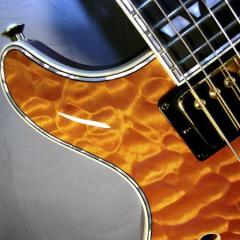
mirrorimij Posted July 22, 2013 Posted July 22, 2013 Obviously, the highest grade flame maple went to the most expensive models. Frank and or Jol were often involved in re-grading maple after we received it into inventory. They routinely downgraded stuff and sometimes just sent it back to the supplier. I believe they paid a premium to have the option to send sub par wood back.Edited to add that Jol sometimes had me weigh the body blanks and we added that to the sorting criteria. That didn't always happen. If a customer specified a light piece of wood, we would go to great lengths to accommodate them.
crunchee Posted July 22, 2013 Posted July 22, 2013 I threw away a LOT of wood over the years that easily would have made it onto other brands guitars. Frank and Jol were picky to the extreme. After the move to CT, they used to send Newman and I to the wood supplier to hand pick our boards. For a short time we actually used the same supplier we used in Arlington Heights.The new plantation mahogany used by a lot of companies is garbage. I worked for a machine distributor for some time and I'm pretty sure some of the machine skids were built out of the same stuff that passes as plantation grown mahogany.I remember reading an article in Vintage Guitar Magazine that specifically mentioned Hamer's selectivity in wood purchasing, I think that was in the October '95 (Vol. 10, No. 1) issue that had Marty Stuart on the cover, there's a bunch of those on FeeBay if anybody is interested in looking it up. The first line of Mirrormij's that I just quoted was said almost exactly in that copy of VG. That article, as much as anything, is a major reason why I got hooked on Hamers, especially in my pre-Internet(s) days.
ArnieZ Posted July 22, 2013 Author Posted July 22, 2013 OK so now we're moving in the right direction . This is esp great information for those who didn't have the good fortune to go to an HFC open house. How about neck and body matching? Any different criteria for different models? Any criteria for matching necks and bodies at all?ArnieZ
cmatthes Posted July 23, 2013 Posted July 23, 2013 If they saw "Arnie Z." on the C.O. spec sheet, they always pulled the Ovation scrap wood across the floor...
ArnieZ Posted July 23, 2013 Author Posted July 23, 2013 If they saw "Arnie Z." on the C.O. spec sheet, they always pulled the Ovation scrap wood across the floor... That's because they had a deep understanding of what I wanted and they never disappointed!ArnieZ
mirrorimij Posted July 25, 2013 Posted July 25, 2013 Arnie, I hope Newman and Northfield chime in as they were directly involved in the process of mating the necks to bodies. In Arlington Heights, the neck department and body department were separate departments. In a hypothetical scenario, lets say they were doing 100 units a week. Lets say 50 were Studio Customs, 25 were Special P90 and 25 were Studios with wrap tail bridges. The necks would all be mahogany with 3 x3 pegheads. However when the necks are built, they will get features that automatically segregate them. The Studio Customs would be bound and crown finger boards, the Special and Studio Wraptail would be rosewood dot fingerboards. Later in the process, the necks would get the pitch angle machined on the heel. This process would separate the rosewood dot necks into two categories- one pitched for the Special TOM bridge, the other pitched for the Wraptail. So in the process where the necks were mated to bodies, you would have the exact number of necks required for each type of body they were running. From there they were mostly matched by color and grain pattern. As far as I know they were never tone tapped or anything like that.I'm sure the guys probably changed things after I left and Hamer scaled back production to only a few units a week. Maybe they can chime in.
Jackass Posted July 25, 2013 Posted July 25, 2013 The string should be re-named Woods-Northfield/Newman60/Mirrorimij. I can't even spell wud right, that's why I do the last 1/3 of the operation. Whenever I would walk through the woodshop, they would throw wud at me.Bm
Tres Aardvarks Posted July 26, 2013 Posted July 26, 2013 Obviously, the highest grade flame maple went to the most expensive models. Frank and or Jol were often involved in re-grading maple after we received it into inventory. They routinely downgraded stuff and sometimes just sent it back to the supplier. I believe they paid a premium to have the option to send sub par wood back.Edited to add that Jol sometimes had me weigh the body blanks and we added that to the sorting criteria. That didn't always happen. If a customer specified a light piece of wood, we would go to great lengths to accommodate them.I can believe this. I think I had read that somewhere also, but even just looking at my two transparent Hamers you can see the radical difference in the grade. My B12M has lovely flamed maple(it really is great), but hanging next to my Cali (built for NAMM and with Ultimate Grade flame maple) the difference is amazing!! I will say I love that the top pf the bass is one piece of wood complete, not sawn and bookmatched!
Recommended Posts
Archived
This topic is now archived and is closed to further replies.