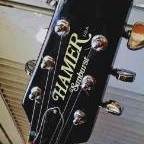
I have these 2 1979 Black Hamer Sunbursts..................the first one I bought is nearly devoid of any finish striations {Finish Checking] ................why I'am I clarifying that? i'm asking the experts. the other one has a lot of checking across the body/neck/headstock all over the black finish. I understand why the 2'd guitar would have these as its spent all its life in Canada..............well Chicago where it was built has its share of very cold weather as well so........... A buddy of mine who owns many Gibson Les Pauls both old and new wondered why the checking is different, [Like with wider [And fewer] spacing between the checking lines on the Hamer] on his older Les Pauls they are heavily checked with very fine lines. So considering both guitar makes/models are finished in "NITRO" why do they look different in that regard? His old Les Paul TV is a solid mahogany guitar just like my Hamer Sunbursts so.......................different "Lacquer" manufacturers/mixs or what? Hmmmmmmmmmmmmm Here is a example of what I'm talking about on a Black 1978 Hamer Sunburst [Thanks for use of your PICs Skip! ]
Question
ARM OF HAMER
I have these 2 1979 Black Hamer Sunbursts..................the first one I bought is nearly devoid of any finish striations {Finish Checking] ................why I'am I clarifying that? i'm asking the experts.
  the other one has a lot of checking across the body/neck/headstock all over the black finish. I understand why the 2'd guitar would have these as its spent all its life in Canada..............well Chicago where it was built has its share of very cold weather as well so........... A buddy of mine who owns many Gibson Les Pauls both old and new wondered why the checking is different, [Like with wider [And fewer] spacing between the checking lines on the Hamer] on his older Les Pauls they are heavily checked with very fine lines. So considering both guitar makes/models are finished in "NITRO" why do they look different in that regard?
  His old Les Paul TV is a solid mahogany guitar just like my Hamer Sunbursts so.......................different "Lacquer" manufacturers/mixs or what? Hmmmmmmmmmmmmm Here is a example of what I'm talking about on a Black 1978 Hamer Sunburst [Thanks for use of your PICs Skip!
  ]
]

12 answers to this question
Recommended Posts
Archived
This topic is now archived and is closed to further replies.