Leaderboard



Popular Content
Showing content with the highest reputation on 04/03/2014 in all areas
-
I learned them pretty early by ear. I learned to play lead by playing with the radio and trying to find notes that sounded right. By doing that, I pretty quickly recognized those five patterns and also learned you could move them around. The nice thing about my local rock station at the time was that there was a mix of styles and keys. You even start figuring out the seemingly weird stuff like Em pentatonic box starting on the 12th fret working over G major and Em but not E major. If the song was in G and I wanted to sound "pretty," I played that box at the 12th. If I wanted it to sound "nasty," I moved that same box to the 15th fret. Not being satisfied with just knowing it worked, I also pretty quickly got into going back and reading why those things worked. I never really learned a lot of licks from tab because I felt like unless you understood why that lick worked over that progression, you weren't really assimilating anything new but just learning how to copy something. When I really wanted to learn a solo, I'd spend a lot of time trying to understand why it worked so if I wanted to screw around with the phrasing and/or playing it in a different key on the fly, I could. It's helpful. For instance, realizing that EVH was really just playing an arpeggio in a different way when he tapped was an epiphany. It helped open up playing improved tapping stuff rather than just learning a part to throw into a solo as kind of a neat trick.1 point
-
any understanding of "Lead " playing or improvisation should start with understanding song structure . popular western music almost always falls into one of three catagories . (using" A "scales as an example )1: A major 1A 2B 3C# 4D 5E 6F# 7G# 8A( half steps between 3/4 & 7/8 ) the chords are 1maj (A) 2 Min (Bm ) 3min (C#m ) 4maj(D ) 5 maj(E) 6 min (F#m) 7 dim (G#dim) = use A scales for Lead ,,,, 2: Am = C ( natural minor ) 1A 2B 3C 4D 5E 6F 7G 8A ( half steps between 2/3 &5/6 ) The chords are 1m (Am) 2dim(Bdim )3major (cmajor ) 4min (Dmin) 5 min (Em) 6major ( F major ) 7major (G major) = use C major scales ( think of them as Am /A root ),,,3: Am = G (dorian minor )1A 2B 3C 4D 5E 6F# 7G 8A ( half steps between 2/3 & 6/7) the chords are 1min (Am) 2min (Bm ) 3maj (Cmajor) 4maj (Dmaj ) 5min (Em ) 6 dim ( F#dim ) 7 maj (Gmaj)= use Gmajor scale ( think of them as Am/A root ) recoginzing which scale to use by what the song structure is,is the trick, now your 5 patterns work in any key , theyre just called all sorts of different names ( what I like to refer to as enharmonic bull shit ) also pentatonics do not make the natural minor/ dorian minor distinction as theres not enough notes in the scale to do so.1 point
-
Pretty simple but still confusing stuff. I had built my bridge to playing noticing that there are three basic patterns building up a position. 1-34 (minor form) 12-4 (major form) 1-3- 1-34 and 12-4 appear in pairs. 1-3- works as a bridge between 1-34 and 12-4. Reading bottom up (horizontally, within a position) -1-34 -12-4 12-4 -1-3- -1-34 -1-34 (Vertically, in fretboard length) For the same string the upper 12-4 in a position is always followed by the 1-3- with 4=1 and 3=1 of building the entrance for the lower 1-34 of the next pattern. 12-4=1-3=1-34 or 12-4 1-34 1-3 The bridges helped me to walk across the fretboard, changing positions, regardless of knowing which pattern actually applies. In order to define myself within a key, I start of with one of the basic patterns and just go ahead from there.1 point
-
Interesting stuff for sure! The 5 pentatonic boxes are also actually modes - a scale form starting on each successive note. I find it's best to think of these things in two ways - 1) as a continuation - the next "form" of a scale in the same key, and 2) as "modes". Meaning, 1) if you are given an A major context, you can use all of the forms of A maj pentatonic up and down the neck as continuations of the original position. This is obviously great for expanding your reach on the neck. Likewise, you can use all of the modal forms or FINGERINGS as continuations of the A maj scale. The 2nd way of thinking is more about treating each mode as a totally separate scale; as different as Major (Ionian) and Natural Minor (Aeolian). They both contain the same exact notes, but their harmonic content is very different in terms of their chords - Major= I, ii, iii, IV, V, vi, viidim and Minor=i, iidim, III, iv, v, VI, VII. This is especially important to learn with all of the diatonic modes, so that when you are faced with a minor i chord and a major IV chord for example, a la "Oye Como Va" starting from Am, you know immediately that you are dealing with Dorian; You have all of the minor pentatonic boxes in Am pentatonic, and all of the "forms" of G major, but need to know where all of your A notes are, and your basic Dorian patterns for a "home base". It is comforting that there are only as many forms/modes as there are notes or starting points. Five notes in pentatonic, 5 forms. 7 notes in diatonic scales, 7 modal forms, 7 different chord sequences. Totally manageable. But I seriously suggest one goes case by case in order of usefulness. For example, you're not gonna find yourself in a lot of "Locrian" jams (hopefully... haha), but after Ionian and Aeolian, you should become familiar with Mixolydian (an altered major scale - maj scale with flat 7) and Dorian (altered minor - nat minor with maj 6). Then Lydian (another altered major scale with #4) and Phrygian (min with flat 2). I learned to do this by analyzing tons of songs I already knew in terms of roman numerals. They're all just major, minor chords and 7th chords. I was really surprised to find that the Police and King's X, The Stones and the Allman Brothers all used different modal progressions, but I learned a ton about using them with this context. Extra credit - Now, if the scales are altered you get 7 MORE different modes. For example A harmonic minor is different from Nat minor because it's spelled A, B, C, D, E, F, G#. Since the G# is altered you get 7 harmonic minor modes that are different from the diatonic ones. And different chords that go with. Same goes for Melodic Minor - 7 more modes. So you've got 7 diatonic modes, 7 melodic minor modes, and 7 harmonic minor modes. But the 5 basic pentatonic boxes are applicable for all cases!1 point
-
Great posts Zorrow! To the OP: personally, I can (and did) read scales, have them shown to me, etc., but until I 'discovered' it for myself, it wasn't mine. One of my fraternity brothers let me borrow some sort of blues scale book around '86 or so - it had all these boxes and I thought, "I'll never memorize all this stuff." I began playing over them and discovered they each contained the same notes (and only 6 - pentatonic plus the flat 5). I then began to map out which notes and it (the obvious) became clear to me. The night after he loaned me the book we were jamming on Johnny B. Goode and I launched into Chuck's solo - he was greatly impressed ('cause neither of us knew how to do that prior). He asked, "where did you get that?" I told him out of the book he loaned me. He said, "just keep it!" My discovery on modes came in nerd school, reading an article in "Guitar for the Practicing Musician" (around '88). Steve Vai was waxing on about this mode is spelled 1 2 3b 4 5 6 7b (that'd be Dorian, IIRC) and that mode is spelled 1 2 3 4 5 6 7b (Mixolydian) and I just couldn't figure out how I was ever going to memorize all that. I began to write the actual notes out on a legal pad along with the modes and the following pattern occurred to me: W-W-H-W-W-W-(H back to the root - where W is a whole-step and H is a half-step) - that's how you spell a major scale. Root to second is a whole-step, then another whole-step to the major third, etc. Starting at the second position, but keeping the pattern static got me the Dorian mode; third position got me the Phrygian mode, etc. Suddenly, I had it! These "modes" were simply a major scale, but started at different positions within the scale. What that gave me for guitar was, I could play any "mode" anywhere on the guitar by simply finding the related and familiar major-scale pattern. Starting at the sixth position gets you the natural minor scale (aka Aeolian mode), by the way. Nerd school did not last long enough for me to figure out the 'harder' things like the modes of the Melodic Minor scale and all that more interesting sounding jazz stuff, but my point is (yes, after all that, there is a point) - I think everyone has to come to the guitar neck in their own way. Taking this information to a keyboard seems (to me) infinitely simpler (though I play keys so seldom, it certainly doesn't appear simple to me).1 point
-
Looks pretty new now!1 point
-
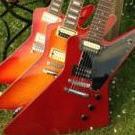
I never had the opportunity to meet, or even converse with, Wyldbil, but from what I have heard about him I'm pretty sure he would wholeheartedly approve and probably say "play the hell out of it boys and girls!"1 point