
jwhitcomb3
-
Posts
4,348 -
Joined
-
Last visited
-
Days Won
3
About jwhitcomb3

- Birthday 03/01/1963
Recent Profile Visitors
4,059 profile views


jwhitcomb3's Achievements

Veteran HFCer (4/4)
962
Reputation
-
 Cool guitars, just not $8500 USD cool. https://www.chicagomusicexchange.com/products/gavilan-miramonte-reverse-silverburst-light-relic-serial-2566061
 -
I assume that Fender went after the name "Danocaster" because they were trying to protect the "XXXcaster" IP associated with a guitar. So that's back to trademark law - protecting Fender's rights to the name in the US, even if they can't protect the shape. As LucSulla pointed out, there are many ways to slice the IP pie, the main IP categories being copyright, patents, trademarks, and trade secrets. And then there is geographic scope, as the IP laws differ by country/region. Even if the laws themselves may be similar, the judicial precedents for interpreting and enforcing the laws may be considerably different in different regions. Patents expire after roughly 20 years, so any inventive aspect of the original Strat has been up for grabs since the 1970s. Patent laws were intended to give inventors a limited term monopoly over their inventions, which thereafter become public domain. This provides incentive to the inventors in the short term before the invention becomes part of society's technology base. Trademarks protect a business entity, not an invention. Trademarks enter the public domain if they become generic due to lack of enforcement by the trademark holder: names like escalator, aspirin, thermos, etc. Add the strat body shape to that list in the United States. But it seems Fender can still protect the name "Stratocaster" in the USA, as well as any variants that might reasonably create confusion in the marketplace. So in the USA, you can produce and sell a strat copy, but you can't call it a XXXcaster. Trade secrets can only be protected as long as they are kept secret. A guitar design is readily apparent, so it's never a candidate for being a trade secret, although a specific manufacturing technique might be. That leaves copyright. Different countries/regions have different time limits for copyrights. Fender seems to believe it has an angle on protecting the strat shape as a work of art in Europe, so they are going for it. So yeah, it's a small piece of the IP pie - but Fender has calculated that the European market for strats is big enough to go after. The present internet kerfuffle reflects the layman's general misunderstanding of both IP and the landscape of international law. Fender's European gambit is not a quest for WORLD DOMINATION OF ALL THINGS GUITAR. It is a corporation grasping at the final available IP straws protecting its cash cow.
-
The legal strategy would be for Fender to go after some of the small fish first and win some cases for relatively small money, which would establish a trail of precedent and make the bigger fish think twice about challenging them.
-
Okay, I'll bite. I've been a patent lawyer for sixteen years, part of my New Hampshire law firm's intellectual property group of lawyers who practice before the United Stated Patent and Trademark Office (USPTO). Which means I know exactly nothing about European copyright law and European judicial precedents. What is interesting to me here is that Fender is not asserting ownership of the functionality of the Stratocaster (which would be a utility patent), the ornamental design of the Stratocaster (which would be a design patent), or the marketplace association of the Stratocaster shape with Fender (which would be a trademark). Instead, Fender is asserting copyright protection in Europe for the Stratocaster as a work of art. I know nothing about the scope of this protection in Europe, or how it may be enforced. Fender is basing its authority upon a European lawsuit that it won by default - basically the other party didn't show up in court to contest the suit. I know nothing about whether this implies Fender indeed has a copyright in Europe, or what rights Fender would have assuming the copyright is valid and enforceable. But Fender has started out sending cease and desist letters based on this default judgment. In the US such letters act to put the recipient on notice of Fender's legal claim, and gives the recipient the opportunity to comply with Fender's demands. Or else. Or else what? Two thought come to mind. One is that Fender would negotiate a license with the recipient. Another is that Fender files a court action. Here, Fender may assume it has sufficient grounds to win such a case on its merits. Or Fender may assume that the recipients don't have the financial ability to litigate the matter, in which case Fender again wins by default. I'm a US patent lawyer, and I can't preduct how all this might shake out under European copyright law. But thankfully, YouTube influencers and social media gurus are all experts. You should believe them, and confidently post your predictions far and wide.
- 77 replies
-
- 10
-

-

-

-
TDC Founder of Fujigen Guitars at 98
jwhitcomb3 replied to BTMN's topic in Hamer Fan Club Messageboard
I own three outstanding 21st century Fujigen guitars (two Ibanez Prestige and a Vox). Just superb. -
New Progessive Rock Band(Get Ready to Gawk)
jwhitcomb3 replied to Dutchman's topic in Hamer Fan Club Messageboard
I'm late to the party - the singer in my band just sent one of their videos. LOVE IT! They balance the trance-y repetition with a good feel for when enough is enough. -
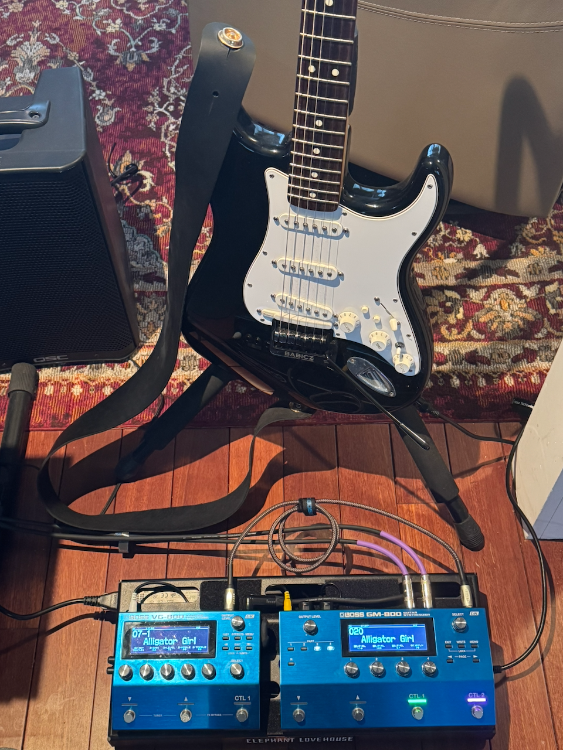
Thanks. I only use the GM-800 (synth) for a handful of songs with my band, typically horns, organ, strings/pads, and pianos, with the occasional analog lead. Just enough to add spice here and there. I use the effects and amp models in the VG-800 for my basic guitar tones and effects (think a slightly pared down Boss GT-1000 CORE), and the VG-800 guitar modeling for songs where I need acoustic guitar, sitar, or open tunings for slide.
-
This is pretty much it.

-
The moderator of the vguitarsforum.com site posted this video showing guitarist Kenny Vaughn demonstrating some crazy licks and chords with a creatively tuned electric 12 string guitar. Check out starting at around 32 minutes: Apparently the tuning Kenny Vaughn uses is a variant of an earlier tuning by Jimmy Bryant (Google the "The Stratosphere Boogie" and "Stratosphere 12 String Tuning"). There are disagreements about the exact tuning Jimmy Bryant used, but here's one I've been messing with from https://www.tdpri.com/threads/stratosphere-12-string-tuning.154839/ The Jimmy Bryant tuning Low E -> Ab - E C - A F - D B - G D - B High E > G - E and the Kenny Vaughn tuning. Low E> A/F A> C/A D> F/D G> A/F B> C/A High E> E/C Jimmy Bryant's tuning is based off a standard tuning for the fat strings, while the Kenny Vaughn tuning is based on an Fmaj9. The string pair intervals are the same (major or minor 3rd) except for the high E, where JB has a minor 3rd and KV has a major 3rd. If you've got one of the wonderful Hamer 12 strings and some time on your hands, these tunings are really inspiring! I no longer have a 12 string, so instead I've programmed the (rather amazing) Boss VG-800 virtual guitar modeler to emulate these tunings. I've attached a brief damo. If you happen to have a Boss VG-800, you can download my presets here: https://www.vguitarforums.com/smf/index.php?topic=39279.msg289103;topicseen#quickreply_anchor Les Paul Multitrack Demo 16.mp3
-
15 Boss pedals in one. New PX-1 Plugout.
jwhitcomb3 replied to Saul Goodman's topic in Hamer Fan Club Messageboard
Yes. I have a desktop computer, an iPhone, and an iPad - I greatly prefer the iPad. I have an iPad holder on my mic stand that wirelessly sets up my Boss GT1000CORE on the floor when I tap the song title in the setlist. The Korg Gadget app on my iPad has been my main compositional tool for the last ten years. I no longer have (or miss) having a laptop computer. -
15 Boss pedals in one. New PX-1 Plugout.
jwhitcomb3 replied to Saul Goodman's topic in Hamer Fan Club Messageboard
I hear you. On the other hand, my nightmare is a huge pedalboard with each device only delivering one sound (without fiddling with the knobs), and then having to re-organize and re-wire the whole setup when I make changes. I want a small board with a maximum of 5 foot switches that perform the same kind of function for each song so I can sing and play without having to tap dance or otherwise think about my gear while performing. The trade-off is it requires much more thought and setup ahead of time. I just want to think about my performance at a gig - and a small footprint (battery powered) for small stages and fast setup/teardown for multi-band gigs. My choice if I want to use my amp of just go front of house with the same foot rig. -
15 Boss pedals in one. New PX-1 Plugout.
jwhitcomb3 replied to Saul Goodman's topic in Hamer Fan Club Messageboard
So if you have the Plethora X3, you have three effect slots/blocks available. Say you have a delay in block 1, a tremolo in block 2, and a phaser in block 3. You have to set the tap tempo for each of these individually which is a hassle, and then it is nearly impossible to get the same tap tempo for all 3. Not a big deal if you set and forget, but it is if you need to change the tempo for each song (for example, to match to the drummer's tempo). For me the frustration is that while the capabilities of the toneprint effects are amazing, most of the really cool stuff is under the hood and only accessible via the editor, where there are a TON of parameters, and you can set up each knob to do exactly what you want (set a single knob to crossfade two parameters, and set the whole range of the knob to be useful). For example, the HyperGravity compressor lets you do things like 3-band compression, and is one of the few pedal compressors that lets you control or defeat automatic makeup gain (so it acts like a real studio compressor rather than a noisy sustainer). Here you can boost and compress the midrange for a solo without getting a fizzy high end or a farty bass. I've dialed in some great sounds on it, but the editor interface is much better on the computer than on the phone. So if you edit and save your toneprint on your computer, you cannot transfer that toneprint to your phone, and even if you only use one device, you can't move your toneprints to your next phone when you upgrade. Even if you don't edit the individual effects, the real power of the Plethora X3 is being able to have a different set of 3 effects available for any particular song or gig. If you spend any time setting this up, it can't be backed up and restored from your phone/computer. So if your X3 needs a factory reset (and these things are buggy), or if you replace a broken unit, you have to set up the whole fucking thing again from scratch. Note that these were limitations of the devices when I looked into them when they were released. I don't know if t.c. electronic (now owned by Behringer) ever addressed these problems. But the Sweetwater reviews of the Plethora X1 (released earlier this year) are a shit show. Edit: It looks like this spring they released an update that addressed some of the tap tempo issues. -
15 Boss pedals in one. New PX-1 Plugout.
jwhitcomb3 replied to Saul Goodman's topic in Hamer Fan Club Messageboard
I looked into the Plethora X5 and X3 when they were announced. I'd owned some tc toneprint pedals and thought they sounded good and were very flexible, but t.c. electronic really botched the tools for editing and restoring toneprints - you could only back them up to a specific computer, phone, or tablet, and there was no way to transfer those backups to another device. So unless you keep the same phone forever, you'll eventually lose any of your toneprints. While individual slots could have a tap tempo, it was on a per-block basis. And their documentation and support was terrible. So if you are happy with the toneprints that ship with the unit and don't want to use the editor, go for it. I decided to steer clear. -
15 Boss pedals in one. New PX-1 Plugout.
jwhitcomb3 replied to Saul Goodman's topic in Hamer Fan Club Messageboard
Cool toy for the menu averse. Boss multi-effects have been the core of my rig for years (MS-3, GT-1000, GT-1000CORE, now VG-800). -
The Quilter Superblock has active tone controls (boost and cut), so setting the treble to noon is akin to diming the treble on an amp with passive tone controls (cut only). Same goes for the MicroPro, Mach 3, and others. Great amps - just gotta get use to the way they work! They can really nail an edge-of-breakup Fender Deluxe tone (my bread-and-butter).