Jump to content
Hamer Fan Club Message Center
  • 0

A question about guitar wood, pickups, tone etc.


Punkavenger

Question

Posted

My question of the day is "How in the Holy Hell does a guitars wood influence the tone when the pickups aren't even touching the wood?"

Some pickups are screwed directly into the guitar body ... I can see, possibly, with my limited scientific knowledge, how the wood would influence the tone in this case.

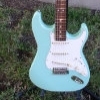
However what about guitars where the pickups are screwed to the plastic pickguard, like Strats for example.

Is it weight, wood density, some random combination of ingredients contributing to create a vague sort of mojo?
Edify me o great and all knowing HFC

15 answers to this question

Recommended Posts

Posted

That's one of the ever lasting questions that will never receive a clear answer!

Physically, strings and pickup create the tone. Frequences of body movement effect the strings. There you go.

Posted

All the really great sounding electric guitars I've played, sounded fantastic unplugged, that warmth, snap, ring, and sustain you hear acoustically is what the pickups turn into a signal to feed into your amp.

Posted

I do believe it does influence. I've heard it, in my guitars as well as in zorrow's guitars.

It's even more explicit if you have a neck though on it.

The old saying "a slab of mahogany with pickups" is true

Here's an interesting article, where i got my info the first time i was shopping.

Another one on guitarplayer:

As a rule of thumb that i (took from zorrow) use : if it sounds great unplugged, is a phoking awesome tone axe

Then if the pickups don't reflet that, change them.

i can distinctly hear a difference between my FM Special and my P90 Special, same with the Cali.

I hope one day to get a big fat Hamer with lots of mahogany on it, no chambering (cause that for pussies) and a neckthrough...and p90s...and boomers!!! :)

Posted

This was an argument we got into in college where it was posed to me wood makes absolutely no difference. I happened to have my first Sears plywood guitar with me, so I pulled the humbucker out of my SG and slapped it into the plywood guitar. It continued to sound like the cheap piece of sawdust and glue that it was. Slapped the humbucker back into that beautiful slab of mahogany and it sounded terrific again.

The way it works in my mind (your universe may differ), wood absorbs some frequencies and reinforces others. This possibly translates to certain overtones being reinforced and some being absorbed (eliminated) in the vibrating string. The vibrating string's mechanical energy is what is converted into electrical energy when the string moves in the magnetic flux field of the pickup.

Posted

There is some research article around explaining that one pickup put into different guitars created the same electric signal. The researchers were analysing the final signal visually and could not find a difference. Sound differences were explained in the dampening effect of different woods. So the string movement in softer wood based guitars would not last as long as for harder wood guitars. Kind of a sustain thing.

Definitely the hearable acoustics of an electric guitar does not have an effect on the tone. That doesn't mean that a good sounding dry played electric solid body may be no indicator for a great sounding electric tone. A great sounding guitar would certainly swing evenly whether played dry or electric no matter the wood it is made from.

Posted

This comes up a lot first a few simple to understand generalizations;

The first biggie, good tone is an opinion, not a fact. And even cheap guitars are made following the same laws of physics. Nowadays, even cheap guitars are actually made pretty well. And the difference in the details is getting smaller every day. People seem to think there is some conspiracy to sell them expensive tone woods, when the truth is, most tone woods are actually pretty cost effective to use. And guitar manufacturing is a pretty small market for wood.

Now let’s get on with it.

A rigid high mass guitar has more sustain. It has to be a “rigid” mass too, a block of hard rubber is high mass, but it’ll absorb almost all the vibrations. But note, more sustain doesn’t necessarily make a better sounding guitar. What we call Tone does. Otherwise maybe all guitars would be made of aluminum or carbon fibers and everyone would be happy.

Aluminum guitars sound like crap IMHO, so do brass and plexiglass ones. Ibanez dragged a brass monster around in the 70’s and it sustained like crazy, sounded like crap. There was no complexity to the notes; they just went "Ping…" but for ages. I had an aluminum necked Kramer, same thing.
BTW aluminum may be a light weight metal, but it’s a lot heavier than wood.

Newton’s First Law, “Every object in a state of uniform motion tends to remain in that state of motion unless an external force is applied to it.” Basically, something moves until it's stopped by something. So the fact that a note fades, tells us that that energy is going somewhere. Some drag from the pickup, air resistance maybe… something else is going on.

We also have to remember Newton’s Third Law “For every action there is an equal and opposite reaction.” If the string vibrates, so do things connected to it, and the better they are connected, the more efficient is this transfer of energy. A guitar vibrates with equal energy as the strings do. Of course the mass of the guitar will spread out that string’s energy pretty far. That .00001 oz string moves a whole lot more freely than that 10 pound guitar will, but with the same amount of energy! If you don't think your guitar vibrates, just strum the strings and lean your guitar against a door and listen.

A resonant piece of wood affects the tone of a note by absorbing some frequencies and reinforcing others. A resonant body tends to have less sustain un-amplified for the simple reason the energy has been used to make the body vibrate, so much so that you can hear it. And once you realize that a rubber guitar, a brass one, a wood one and a plastic one would sound different, you must agree that different woods will also make a difference, though to a much smaller degree. And remember even cheap guitars are made out of woods chosen for their tone, not just price. Cost effective tone woods sound better then a guitar made of wet noodles.

Now a body made of MORE Pieces means you have pieces with slightly different nodal points and being glued together, the'll vibrate a lot less then a free vibrating piece. In the late 70's there were a number of custom manufacturers who made what later were called breadboard guitars, and while they looked killer, they weren't very tuneful IMHO. Many people who use heavily EQ'd pickups, like many active pickups don't seem to care.

Now the complexity of tone comes in;

Why do guitarists find they love the tone of electric guitars that sound great acoustically, if they have less sustain? Hint, have you ever hit a note and stood just in the right place by your amp and it sustained forever? Right, not only is the moving string vibrating the body, the vibrating air is moving it too, and that moves the strings again. The louder your amp, the more your guitar vibrates. This acoustic coupling has an effect on tone and sustain, and a good sounding guitar acoustically, has the tonal properties you prefer that can now be acted upon, and reinforced, by the moving air.

Now once you realize that a guitar body moves, even slightly, you also note that the pickup is mounted to the body and it will vibrate the same as the body does. Some reinforced, some attenuated. Remember leaning your guitar against a door? A pickup doesn’t know the difference between the string moving in front of it, or its motion under the string. It’s the changes in the magnetic field that gives the output, and those changes are the same if the string moves or the pickup does. So the strings moving in front of a pickup, that’s also moving, but slightly differently because of the absorption and reinforcement characteristics of the body, will affect the tone too. That’s why some people go to great lengths to mount a pickup directly to a guitar’s body and not use springs or a pick guard for support. It’s to get as much of that energy and body effect as possible.

Vibrate.gif
If you pluck the string on the left, the one on the right will ring in sympathy showing the vibration travels through the wood. Different woods or other materials will affect how accurate the transition is (and you might not want accurate!).

vibrate2.gif
If you vibrate the string at a certain frequency you'll get a tone. You'll also get a tone by virbating the pickup. So if the pickup is mounted to a body that vibrates, it'll have an effect.

Then why do some people like a Strat with its pickup’s spring mounted to a pick guard? They like the tonal effects of that. Remember, tone is an opinion, and that’s just one of the many reasons a Strat doesn’t sound like a Tele, Explorer or Les Paul.

Posted

bend1.gif

Bend2.gif

Here's a view of the same body vibrating at different frequencies (exaggerated for clarity)... you can see how some notes are going a touch sharp and flat and at different times and different rates, once again making the tonal balance of one guitar a touch different then another, or one of a different material.

Posted

Try looking here at Warmoth. I found these to be good intro guides to guitar woods. Enough info to make you sound witty and knowledgeable at the next office Christmas Party. Nothing more riveting than a lively discussion about guitar woods. However check with the Justice Department before you dive in. They confiscated Gibsons inventory of ebony.

Agents last seized guitars and wood from Gibson in 2009, and the resulting case continues under the title "United States of America v. Ebony Wood in Various Forms."

Warmoth Body Wood Guide

Warmoth Neck Wood Guide

Posted

Walk in to a big guitar store, where they have fifty or sixty Strats ( for example ) on wall hangers, strum the open strings on each in turn, put your pinky lightly on the body to feel how much it resonates, even amongst identical models there will be significant differences; of those fifty or sixty guitars, a couple will sound exceptional, most will sound decent, and there will likely be a few uninspiring examples. When helping friends choose a guitar I have learnt to gravitate towards the most resonant ones, before plugging them in to an amp; these guitars have identical hardware, and very similar wood types, yet within half an hour or so you can narrow it down to one or two really good sounding specimens.

So from the opposite end of the question, what is it that makes guitars of identical construction, wood, and hardware selection, sound so audibly different ?

Posted

Try looking here at Warmoth. I found these to be good intro guides to guitar woods. Enough info to make you sound witty and knowledgeable at the next office Christmas Party. Nothing more riveting than a lively discussion about guitar woods. However check with the Justice Department before you dive in. They confiscated Gibsons inventory of ebony.

Agents last seized guitars and wood from Gibson in 2009, and the resulting case continues under the title "United States of America v. Ebony Wood in Various Forms."

Does this mean that guitars and guitar tonewoods can be named as a defendant in a divorce trial? Especially for 'alienation of affection'? :lol::ph34r:

Archived

This topic is now archived and is closed to further replies.

×
×
  • Create New...